
AI is having a moment. In healthcare the pressure to “do something with AI” is everywhere. But here’s the uncomfortable truth: most AI projects fail.
Study after study suggests only a small percentage of initiatives actually deliver meaningful business value. That isn’t because the technology doesn’t work. It’s because too many organizations start in the wrong place. At SoftWriters, we’ve taken a more intentional approach. Rather than chasing hype, we build AI the same way we build everything else: grounded in real workflows, real customer needs, and clear accountability for both operational value and patient outcomes.
Why AI Success is so Rare
Silicon Valley Artificial Intelligence leader and expert, Ariel Jalali, who has spent years working across industries where compliance, scale, and risk collide, shared a critical insight into what separates successful AI from failed experiments.
Ariel pointed out that successful AI initiatives tend to thrive in environments that share a few key characteristics:
-
High-volume, document-driven workflows
-
Environments with significant compliance risk
-
Clear opportunities to improve efficiency without sacrificing quality
-
Long-term care pharmacy fits that profile almost perfectly.
Much of today’s AI investment in healthcare is focused on highly specific use cases. Health systems and physicians are focused on ambient AI documentation and AI-elevated revenue cycle management, retail pharmacies are focused on patient engagement and scheduling solutions, and the largest insurance companies in the world are relying on Artificial Intelligence to review, approve, and deny claims at scale. These applications are often designed for environments that are episodic, highly variable, and dependent on human interaction.
Long-term care (LTC) pharmacy is fundamentally different from other healthcare verticals.
Prescriptions move at scale, errors carry significant clinical and legal consequences, and pharmacy teams operate within highly structured, document-driven workflows. Success depends on consistency, accuracy, and accountability across every step of the fulfillment process. These characteristics closely align with the conditions Ariel Jalali identifies as essential for successful, scalable AI.
As a result, long-term care pharmacy presents opportunities across nearly every stage of medication fulfillment. From order entry and sig translation to pharmacist verification, document management, quality assurance, and delivery optimization, AI-enabled automation can be embedded directly into core workflows where it can operate quietly, safely, and at scale.
Leadership, Not Technology, Determines the Outcome
One of the most common failure modes we see is a top-down mandate: “We need to do AI.”
This approach always produces a lot of activity but without a clear path and explicit strategy, activity without a long-term plan very rarely lasts in impactful, self-sustaining solutions.
The difference comes when leadership understands customer needs, unique industry challenges, and stays involved beyond the headline. AI isn’t a side project or a slide in a board deck. It’s a long-term capability that has to be built with discipline into a strategic roadmap.
That’s been our approach at SoftWriters. We’ve treated AI as an extension of our responsibility to the people who rely on FrameworkLTC every day, not as an experiment detached from real operations.
Data Isn't the End Goal: It's the Path
There’s a popular analogy that data is the new oil. That’s only partially true.
Raw data isn’t valuable on its own. What matters is how it’s refined, contextualized, and turned into decisions. Business intelligence, analytics, and AI aren’t separate initiatives but they’re points along the same journey.
That belief shaped how we built FrameworkInsight.
Dashboards are useful, but they’re not the destination. The real value comes when teams can move from:
What is happening to > why it’s happening > to what’s likely to happen next > and ultimately what should be done about itThat progression is where confidence comes from and confidence matters in clinical environments where decisions affect patient safety.
.png?width=1920&height=1080&name=Graphic%201%20-%20FrameworkRXP%20(1).png)
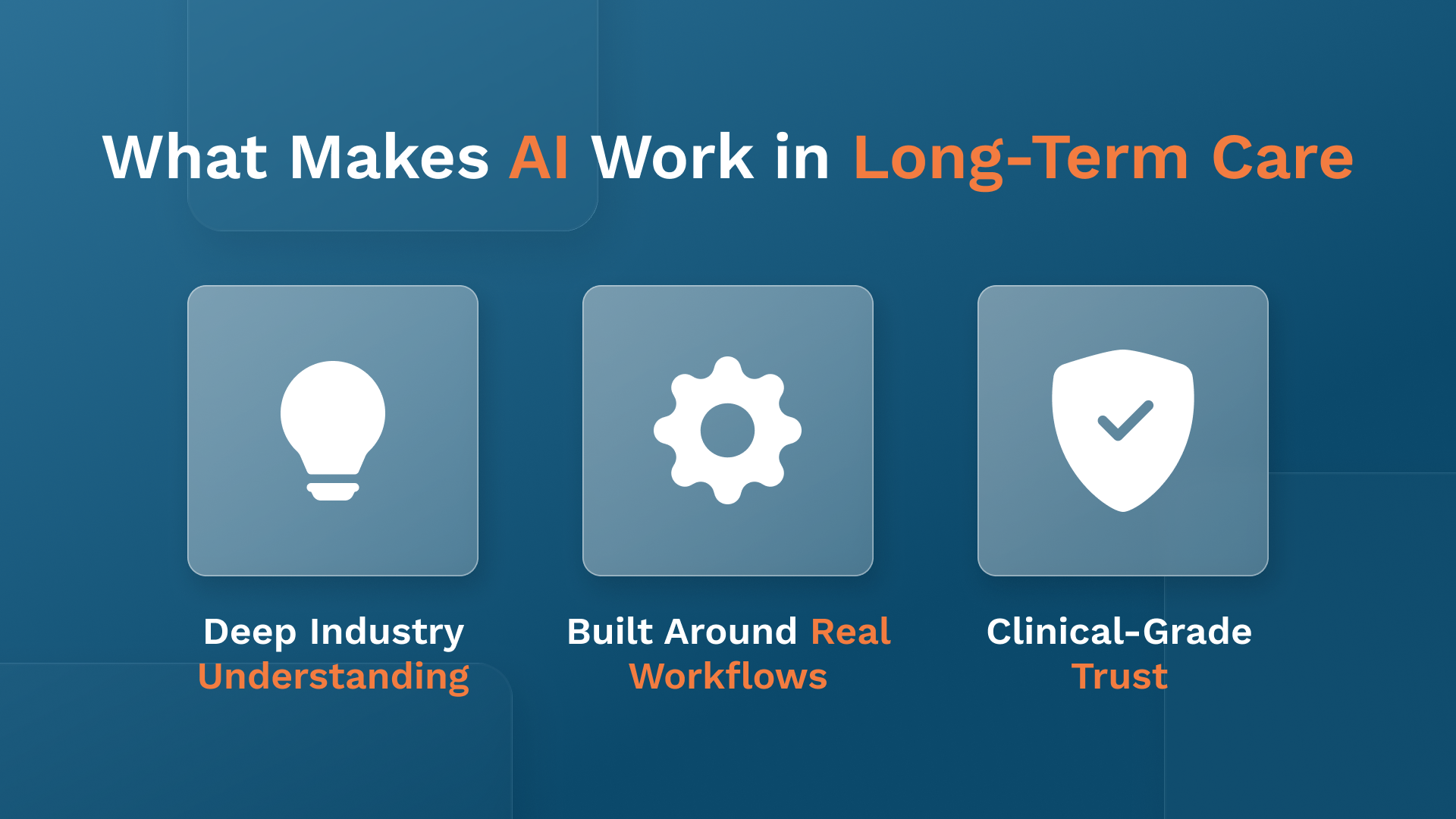
Clinical Grade AI Requires Trust, Not Power
Healthcare doesn’t have the luxury of “good enough.”
The most powerful model isn’t always the right model. In fact, in clinical settings, there’s often a tradeoff between capability and reliability. Bigger isn’t better if it introduces uncertainty.
That’s why we’re focused on:
-
Using the right tool for the right task
-
Combining AI with deterministic checks and controls
-
Building modular systems that can evolve safely
-
Maintaining clear auditability and accountability
Clinical-grade AI isn’t about replacing judgment. It’s about supporting it consistently and responsibly.
Start with Process. Always.
If there’s one principle Jalali wants to emphasize to any organization thinking about AI, it’s this:
Don’t start with the technology. Start with process.
Long-term care pharmacy professionals understand their workflows better than anyone. They know where handoffs break down, where errors creep in, and where time is wasted on low-value tasks.
AI works best when it’s applied to those specific pain points one use case at a time. Not everything needs AI. And not everything needs to be automated.
But the right things, done well, can change everything.
The Future of AI Will Be Quiet. That's a Good Thing.
The most valuable AI won’t demand attention. It won’t ask for prompts or explanations. It will simply work in the background—reducing errors, improving efficiency, and freeing people to focus on what only humans can do.
That’s the future we’re building toward at SoftWriters.
Not AI for show.
Not AI for headlines.
But AI that earns trust, one workflow at a time.
Good today. Better tomorrow. And always built for the people that will rely on it to do it’s job reliably each and every day.

.png?width=352&name=Your%20paragraph%20text%20(Presentation).png)
.png?width=352&name=IC%20Blog%20%231%20Featured%20Image%20(1).png)