Policy changes rarely announce themselves at the workflow level. They show up later, quietly, in a billing discrepancy that takes an hour to resolve, a compliance step that didn't exist six months ago, or a margin that's a little thinner than it was last quarter.
For LTC pharmacies in 2026, the policy environment isn't just shifting in one direction. It's shifting in several at once, and the compounding effect of those changes is what pharmacy operators need to be thinking about right now. This article breaks down what's actually changing, what it means for day-to-day operations, and how teams can start adjusting now to stay efficient, compliant, and financially stable in the year ahead.
From the IRA to Fiscal Reform: What Shifting Federal Policy Means for LTC PharmacyThe LTC Operational Bottleneck
The reimbursement pressure LTC pharmacies are navigating in 2026 did not emerge from a single piece of legislation. It reflects two distinct policy approaches, both aimed at reducing what Americans pay for healthcare, but arriving at that goal through very different mechanisms.
The previous administration's approach was direct and drug-pricing specific. The Inflation Reduction Act signed in 2022, gave Centers for Medicare and Medicaid Services (CMS) the authority to negotiate prices with drug manufacturers for the first time, introduced a $2,000 annual out-of-pocket cap for Medicare Part D enrollees, and restructured how manufacturers contribute to medication costs. Those provisions are now fully operational, with the first ten negotiated Maximum Fair Prices having gone into effect on January 1, 2026 and another 15 drugs entering negotiation for 2027.
The current administration has taken a structurally different path. Rather than building on the IRA's drug-by-drug negotiation framework, the emphasis has shifted toward broader fiscal reform and national pricing alignment. An April 2025 executive order was implemented aimed at developing payment models that better attain value for high-cost drugs, stabilise Medicare Part D premiums, and reevaluate the role of pharmacy benefit managers. A May 2025 executive order then directed manufacturers specifically to offer American consumers the most-favored-nation lowest price available in comparable countries, and instructed the Secretary to facilitate direct-to-consumer purchasing programs at those prices. A government-operated platform launched in October 2025 now allows individuals to purchase certain medications directly from participating manufacturers at discounted prices, bypassing traditional insurance and pharmacy benefit structures entirely.
Healthcare affordability remains a stated priority, and the steps already taken suggest that further programs impacting Medicare reimbursement or how medications are bought and sold directly to consumers are likely rather than speculative. Two proposed rules currently under federal review, the GUARD Model and the GLOBE Model, would extend most-favored-nation pricing into Medicare Parts B and D through CMS demonstration models.
For LTC pharmacies, the combined effect of both policy eras is a reimbursement environment that is more complex, more volatile, and less forgiving of operational inefficiency than anything that existed five years ago. The IRA's changes are already live. The current administration's reforms are still taking shape. What both policy eras have in common is this: the operating environment for LTC pharmacy is more demanding than it was, and it is not moving in the other direction.
The "One Big Beautiful Bill" and What it Actually Does for LTC Pharmacy
Signed into law on July 4, 2025, the One Big Beautiful Bill Act (OBBA) is primarily a tax and economic policy law. Most of the headlines focused on individual tax cuts and clean energy credit changes. But buried inside it are provisions that do have practical relevance for LTC pharmacy operators and the people who work in them.
The most significant for pharmacy is the HSA expansion, which started January 1, 2026:
✔ Bronze and catastrophic health insurance plans are now HSA-compatible, expanding coverage options for pharmacy staff and patients
✔ Direct primary care arrangement fees can now be paid directly from HSA funds
✔ Telehealth services are permanently available before meeting a high-deductible plan deductible without affecting HSA eligibility
For pharmacy staff navigating their own benefits, this opens up meaningful new options. More immediately relevant for operators: the 100% first-year depreciation deduction on qualified business property purchased after January 19, 2025, allows pharmacies to fully write off equipment and technology investments in the year they are made rather than depreciating them over several years. For any pharmacy considering a technology investment in 2026, that is a significant financial consideration worth a conversation with your accountant before year-end.
What OBBA does not do is directly address the reimbursement crisis that is the more pressing and immediate issue for most LTC pharmacies right now.
Inflation Reduction Act (IRA): The Reimbursement Pressure that Predates the Bill
The harder conversation in 2026 is not about OBBA. It is about the Inflation Reduction Act and what Maximum Fair Price means for LTC pharmacy margins.
On January 1, 2026, the first ten drugs entered the Medicare Drug Price Negotiation Program under the IRA, with negotiated Maximum Fair Price rates taking effect. These are not obscure drugs. They are medications that LTC pharmacies dispense at high volume to residents with chronic conditions, and are one of the highest spends annually recurring spends for medicare Part D Reimbursement. The profit margin on some of these drugs could shrink by more than 80% under MFP compared to the previous AWP-based reimbursement model, on a single drug.
ATI Advisory, analyzing data on behalf of the Senior Care Pharmacy Coalition (SCPC), estimated that LTC pharmacies could see their Part D revenues drop by 57% in 2026 when the first set of new prices kicks in. Without relief from Congress, the impact will grow further as another 15 drug prices are lowered in 2027. A bipartisan bill introduced in the House proposed a $30 add-on payment per Part D prescription to soften the blow, and the Senior Care Pharmacy Coalition has been actively building support for it, but the situation remains in flux.
There is also a cash flow dimension that gets less attention than the margin story. Under the retrospective refund model, pharmacies purchase drugs at acquisition cost and wait at least 21 days to receive the MFP refund from manufacturers. For pharmacies already operating on slim margins, that payment timing gap creates real pressure on short-term liquidity.
This is not a theoretical risk sitting somewhere in the future. It is hitting operations right now.
The Compliance Layer on Top of the Financial One
Reimbursement pressure does not arrive alone. The Medicare Prescription Payment Plan (MPPP) requirements that came into effect in January 2025 added new documentation, notice, and tracking obligations across the workflow. Centers for Medicare & Medicaid Services (CMS) has signaled continuation of these requirements for evolution of these requirements into 2026.
Each individual compliance requirement is manageable on its own. The challenge is the cumulative weight of managing all of them simultaneously inside a high-volume environment where the workflow is already stretched. In August, 2025 CMS posted an advisory notice reminding plan sponsors that LTC pharmacy enrollees must be able to routinely receive their Part D benefits through the plan's LTC pharmacy network, but without binding enforcement mechanisms, much of the day-to-day compliance burden falls back on the pharmacy itself.
The result looks like this in practice:
✔ More documentation required at each stage of the order workflow
✔ Additional steps before orders can move forward to fulfillment
✔ More time spent verifying each prescription meets both clinical and billing requirements
✔ Greater exposure to rework and claim rejection when something is missed earlier in the process
✔ Increased risk of MAR discrepancies when pharmacy and facility systems are not properly aligned
Strong billing processes and consistent documentation are not just compliance obligations in this environment. They are also the things that protect revenue integrity when margins are already under pressure.
4 Ways LTC Pharmacies Can Adjust Now
This is the part of the conversation that matters most, because understanding the pressure is only useful if it leads somewhere actionable. The pharmacies navigating 2026 most effectively are focusing on a few concrete areas.
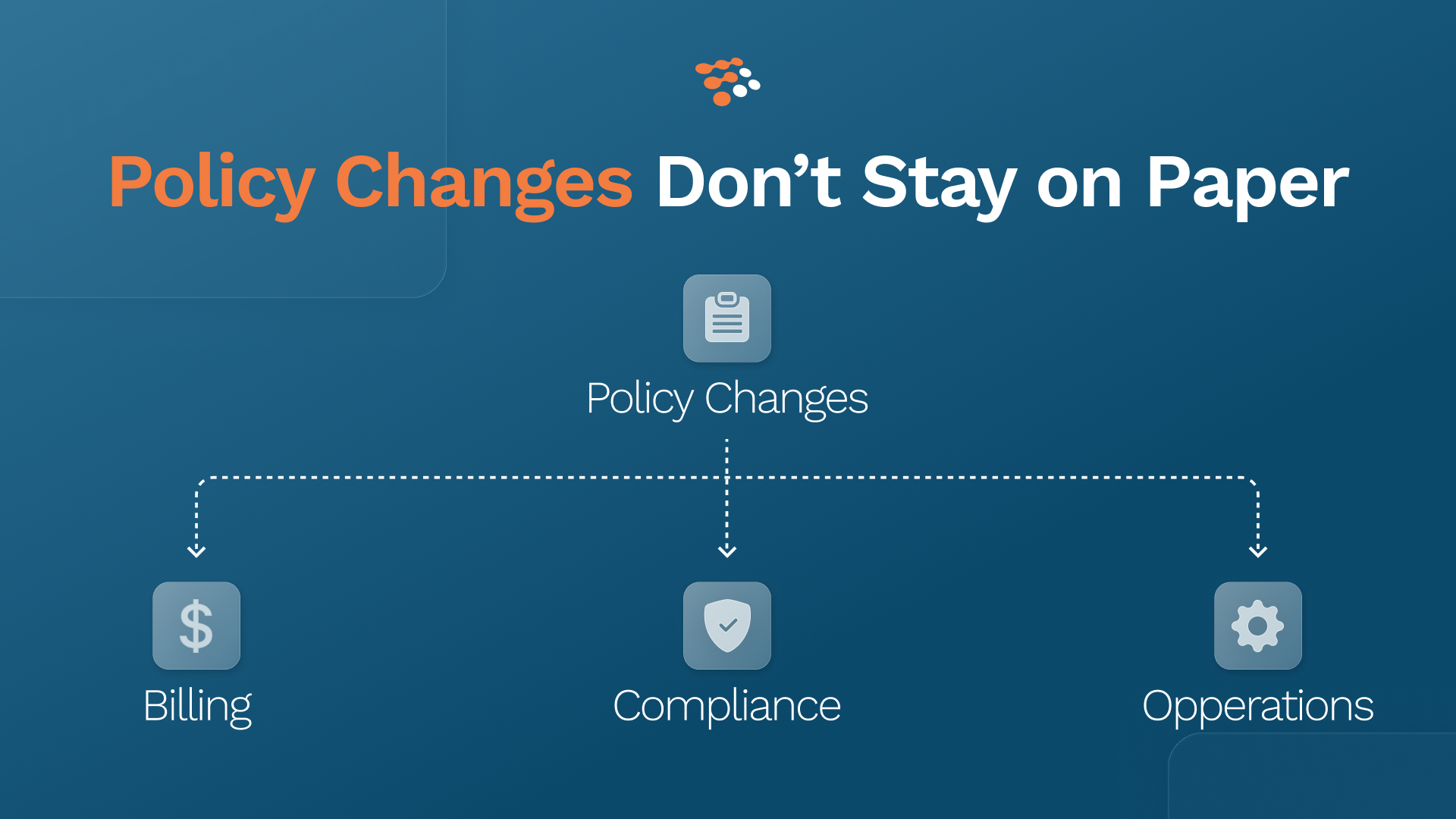
Claim errors and rejected prescriptions are expensive in any environment. In 2026, with MFP claims introducing new billing complexity and the MPPP requiring more precise documentation, the cost of a billing error goes beyond rework time. It affects cash flow, compliance adherence, and the accuracy of the financial picture leadership relies on to make decisions.
One of the most effective resolutions is reducing the volume of orders that are entered manually at the front of the workflow, thereby reducing the opportunity for errors. Errors that originate in order entry compound downstream through dispensing, billing, and reconciliation. Catching them earlier, or preventing them through automation, is cheaper and faster than fixing them later. To reduce the impact of errors and rework, many LTC pharmacies focus on:
✔ Verifying payer eligibility before claim submission rather than after
✔ Documenting medication changes that affect reimbursement in real time
✔ Reconciling claim submissions with facility records consistently rather than periodically
✔ Monitoring rejected claims and rebilling workflows as a daily operational metric, not a monthly one
✔ Maintaining MFP-specific documentation that supports CMS and payer audits as those claims are processed
Build audit readiness into the workflow, not onto itOne of the more common mistakes pharmacies make is treating compliance documentation as something that happens after the clinical and operational work is done. That approach worked when volume was lower and requirements were simpler. It does not scale well in the current environment.
Audit readiness in 2026 means documentation that is created as part of the workflow, not assembled after the fact. This includes tracking which drugs are subject to negotiated MFP pricing, logging how claims are processed under the new reimbursement model, and maintaining clear records of MPPP notices and patient elections. When documentation is embedded in how orders move through the system, compliance becomes a byproduct of good operations rather than a separate overhead.
Reduce the manual work that is inflating cost per prescriptionLabor accounts for between 40% and 60% of LTC pharmacy operating expenses. In an environment where reimbursement is falling and prescription volume is not, every manual step in the workflow has a direct cost. It is not just the time spent. It is also the error rate that comes with manual processes, the rework that errors generate, and the downstream billing corrections that follow.
The pharmacies managing cost per prescription most effectively in 2026 are the ones that have reduced manual touchpoints across the workflow, particularly in order entry, which remains the most labor-intensive step in the process. Automating order entry does not replace clinical judgment. It removes the clerical work that sits underneath it, so the team's time is spent on verification and oversight rather than transcription.
Use data to see what's coming before it arrivesOne of the less visible operational risks in 2026 is the speed at which the financial picture changes. A shift in which drugs fall under MFP pricing, a change in payer behavior, or a spike in claim rejections can move margins quickly in ways that are not obvious until they have already compounded.Pharmacies building data visibility into their operations, specifically around MFP-impacted claims, Part D revenue trends, and billing reconciliation, are better positioned to catch those shifts early and respond before they escalate. Early trend detection and financial risk modeling are not just strategic concepts. In this environment, they are operational necessities.
Where this Leaves LTC Pharmacy Operations in 2026
Put all of this together and the picture that emerges is not panic, but it is pressure coming from multiple directions simultaneously. Margins are tighter, compliance obligations are heavier, the labor market has not loosened, and the traditional response to growth and volume, hiring more people, is getting harder to sustain.
The pharmacies positioning themselves well for this environment share one thing in common: they stopped treating operational efficiency as a project for someday and started treating it as the foundation they were already building on. The pharmacies that come through this period in the strongest position will be the ones that made that shift before the pressure forced it.
Platforms like FrameworkLTC, and FrameworkLTC+™ – our latest AI-powered order entry capability, are built to support how pharmacies handle this environment, helping teams reduce manual friction, improve billing consistency, and maintain the level of audit visibility that compliance in 2026 demands. The goal is not to add another layer of technology. It is to make the existing workflow perform more reliably under conditions that are genuinely more demanding than they were a year ago.
Policy Changes are Already an Operational Reality
The One Big Beautiful Bill will continue to generate headlines. The IRA reimbursement changes will continue to evolve. And the compliance expectations around Medicare Part D will keep moving.
For LTC pharmacies, the most important question is not what is changing in Washington. It is whether the workflow inside the pharmacy is built to absorb that change without disrupting care, overloading staff, or eroding margins that are already under pressure.
The pharmacies that figure that out now will be in a fundamentally different position than the ones that wait.
See how FrameworkLTC, and FrameworkLTC+™, work together to reduce manual work, improve billing accuracy, and support compliance with 2026 LTC pharmacy regulations. Schedule a consultation.
FAQs: LTC Pharmacy Regulations and Updates in 2026