There’s a point in the workflow where things begin to slow down and stack up. In LTC pharmacy, that point is often order entry. The moment a technician opens an eRx message, reads through the details, and manually keys everything into the system.
One prescription at a time.
- 13-19 clicks on average to process one new order
- Simple orders take up to 90 seconds to enter
- Labor accounts for 58% of dispensing costs
Multiply across daily LTC prescription volume, it becomes clear this is the point where operations quietly break down.
The LTC Operational Bottleneck
Order entry sits at the front of the workflow, but its problems ripple through everything downstream. A missed field here, an incorrect selection there. Nothing catastrophic on its own, but the rework accumulates. Billing gets delayed, fulfillment slows. And because this is LTC rather than retail, the stakes are higher. Real LTC residents are waiting for their medications.
To add to the LTC bottleneck, LTC order entry roles are among the highest to staff.
High turnover, repetitive work, and a tightening labor market makes it impossible to hire your way out of the problem. Pharmacy leaders end up spending critical time and money recruiting, onboarding, and backfilling; a cycle that drains resources without actually solving the underlying problem.
This is exactly where AI-driven order entry is changing the equation.
Why Native AI Order Entry Outperforms Third-Party Tools
Automated prescription processing isn't a new concept. The way it’s implemented makes all the difference.
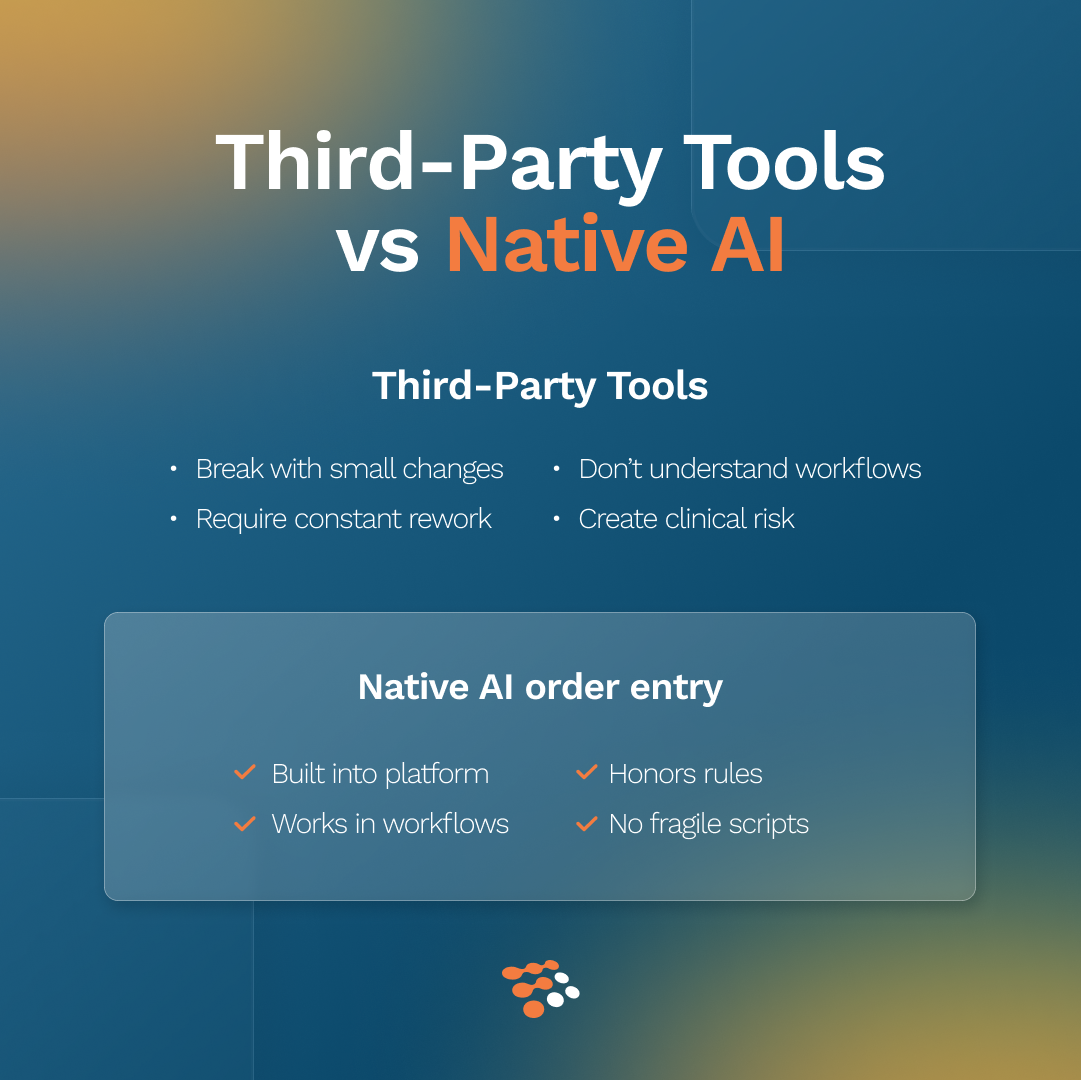
Some tools take the shortcut such as:
-
screen scraper
-
auto-clickers
- scripts that mimic human behavior
These shortcuts are fragile.
Move a button? The script breaks.
Change a workflow? Someone has to rewrite the automation.
In a clinical environment, fragility isn’t an inconvenience—it’s a risk.
Native AI Order Entry
This is where AI-driven order entry systems like FrameworkLTC+ take a fundamentally different approach
Because the AI is embedded directly into the platform, it:
-
Operates inside existing workflows
-
Honors business rules and configurations
-
Requires no screen scraping
-
Avoids brittle scripts
-
Rolls out with direct SoftWriters guidance
This means pharmacies aren’t left to figure out implementation alone. The system is configured around how the pharmacy actually operates.
What Native AI Does Inside the Workflow
FrameworkLTC+:
-
Interprets incoming prescription data
-
Selects the correct drug and NDC
-
Populates required fields
-
Handles therapeutic interchange
-
Applies formulary preferences
-
Manages biosimilar substitutions
-
Translates structured sigs
-
Moves the order forward automatically
Every action is logged with full field‑level audit history, which is essential as state and federal AI regulations evolve.
Auditability is the foundation, not just a feature.
What This Means for Your LTC Team
“AI allows us to automate the clerical work that takes us away from real patient care," said alpha partner, Tara Nasso, CPhT, Business & Finance Director at LI Script Pharmacy.
For pharmacies watching reimbursement pressure tighten each year, that shift carries real financial weight. When automation supports the repetitive volume, pharmacies can improve margins per prescription by processing more with the team they already have, creating operating leverage that shows up meaningfully in EBITDA.
At the team level, it also changes how time is spent. With order entry supported by the system, pharmacists and technicians can redirect their attention to verification, facility communication, and clinical questions—the work that truly requires their license and judgment.
As Michael Shamalov, R.Ph., CEO and Founder of LI Script Pharmacy, put it: "Instead of spending time on manual tasks, pharmacists can focus more on helping nurses and answering clinical questions.
Scale Without Complexity
Every new facility contract and every bump in prescription volume has historically created the same pressure: hire more order entry staff. That logic is getting harder to sustain.
With AI Order Entry, pharmacies can absorb higher volumes without scaling their teams at the same rate, because the automation is configurable around how the business actually runs - volume thresholds, controlled substance handling rules, the ability to turn processing on or off as operational needs shift. Growth happens on the pharmacy's terms rather than being dictated by staffing capacity.
"Automation and AI are what allow us to process massive volumes of prescriptions accurately and safely," said Shamalov. "So far the AI processing has been absolutely amazing."
The Bottom Line: Order Entry Isn't Going Away but Manual Entry Should
Order entry will always be part of LTC pharmacy operations. But how it gets done is changing.
The pharmacies that get ahead of this shift will be better positioned to improve accuracy, deliver better resident care, and scale without being limited by staffing constraints.
FrameworkLTC+, AI-Powered Order Entry, was built specifically for the LTC environment. It is native to the platform, audit-ready, and designed to support the way LTC pharmacies actually work rather than layering on another system to manage on top of the one they already have.
FAQs